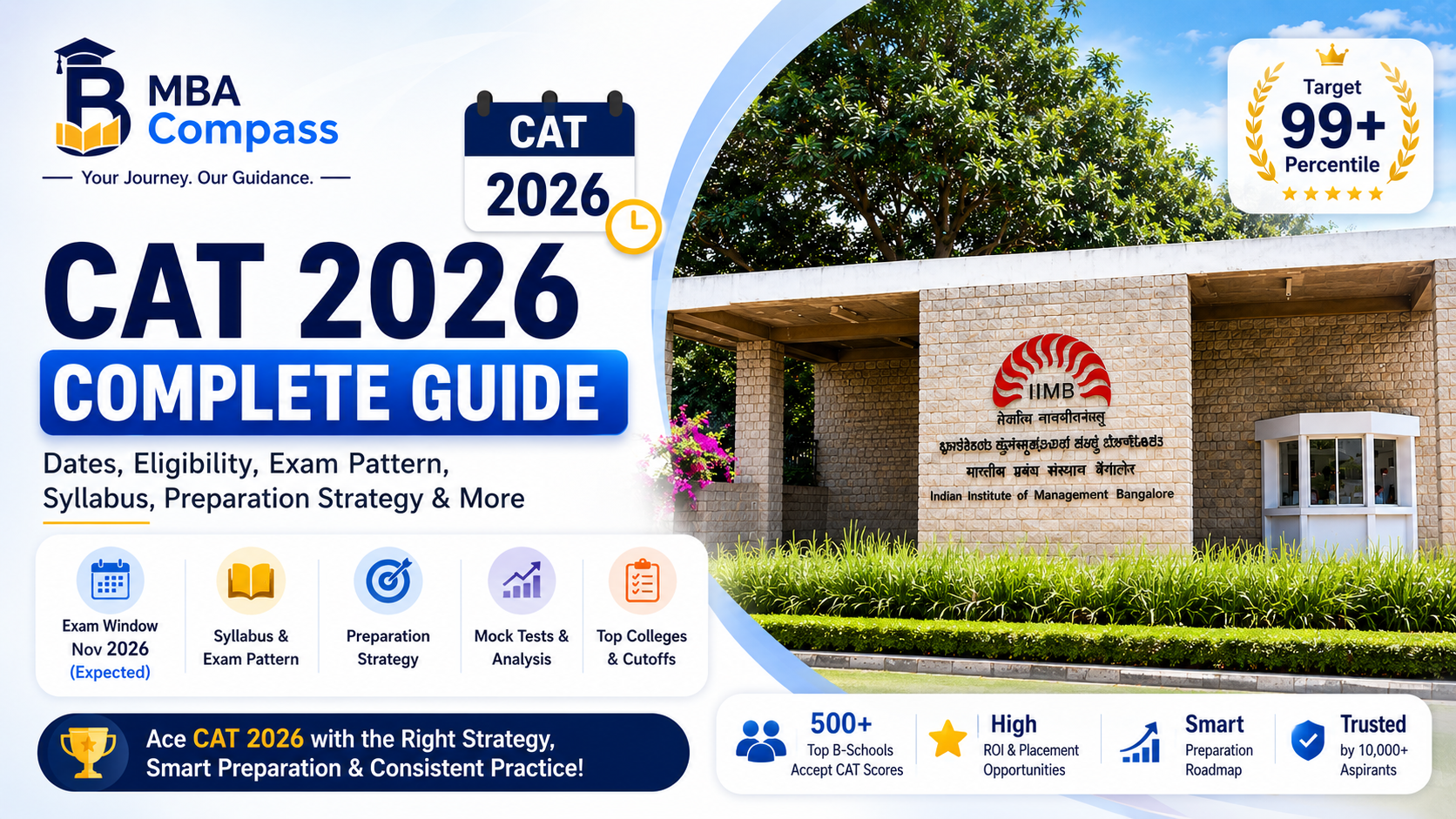
A focused CAT 2026 preparation timeline for a 99 %ile needs a structured plan of focused study over 6–9 months, with progressive mock testing and targeted sectional goals.
Expect to invest 12–18 weeks of core study blocks and ramp up mocks to reach 40–60 full-length mocks before the exam window; aim final peak weekly hours at 20–25 hours.
Based on official exam patterns for CAT and comparison with XAT prep intensity, this timeline emphasises Quantitative Ability, Verbal Ability & Reading Comprehension, and Data Interpretation & Logical Reasoning.
Snapshot bullets
Expected duration — 6–9 months of focused preparation depending on your base (fresher vs 2+ yrs work-ex).
Weekly hours — start at 8–12 hrs/week in month 1, reach 20–25 hrs/week in the final 6 weeks.
Mock count — plan for 40–60 full-length mocks (combination of sectional and full tests) spread across the timeline.
Target percentile — aim for sectional goals: VARC 98–99 %ile, DI-LR 98–99 %ile, QA 99 %ile.
Sectional goals — VARC: 10–12 RC passages/wk; DI-LR: 6 sets/wk; QA: 200–300 problems/month across topics.
Top topics QA — Number Systems, Algebra, Geometry, Permutations & Combinations, Probability, Time-Speed-Distance, Work-Time.
Top topics DI-LR — Tables, Bar/Line graphs, Caselets, Critical reasoning sets, Inference-based logic puzzles.
Top topics VARC — Long RC, Short RC, Para-jumbles, Para-selection, Summary questions.
Metric | 6-month plan | 9-month plan | Expectation | Notes |
|---|---|---|---|---|
Official window 2026 | Official window 2026 | End-Nov 2026 expected | Verify with IIM official release | |
Use early months for basics | Extra buffer for work-ex candidates | Adjust to XAT Jan 2027 schedule | Parallel practice recommended | |
Mocks required | 40 | 60 | Sectional + full-length mix | Increase frequency near exam |
Weekly peak hours | 18–22 hrs | 20–25 hrs | Final 6 weeks intensity | Include review & weak-topic drills |
Target percentiles | VARC 98–99 %ile | QA 99 %ile | DI-LR 98–99 %ile | Aim sectional balance for IIM calls |
Benchmark colleges | IIM-A, IIM-B, IIM-C | XLRI, FMS, MDI | NMIMS, SPJIMR as options | Based on NIRF 2026 and placement trends |
Mentor tip: Want expert guidance for MBA admissions? Connect with our mentors today via the Profile Analyzer and shortlist target colleges with the College Shortlister.
Month-by-month preparation timeline
Direct answer: Build a 9-12 month CAT 2026 preparation timeline by starting with fundamentals, adding sectional strategy in months 3-6, and moving to intensive mocks and revision in months 7-9 to hit a 99 %ile target.
Summary: This month-by-month plan gives you weekly-hour targets, mock score goals, and decision rules so you know when to accelerate or change strategy. It fits freshers, engineers, and professionals aiming for IIMs, XLRI, FMS, SPJIMR and NMIMS.
Follow a disciplined weekly load and weekly mock cadence. Based on placement reports and admission trends for 2026-27, top IIMs demand strong VARC and DILR while FMS and MDI value consistent QA scores.
Monthly plan table
Month | Focus topics | Weekly hours | Target mock outcome | Decision rule for next month |
|---|---|---|---|---|
Month 1 (Foundations) | Basics: arithmetic, grammar, reading habit | 12-15 hrs | Take 1 diagnostic; baseline 40-45 %ile | Move on if accuracy >70% in basics |
Month 2 (Concepts) | Algebra, geometry, RC strategies | 15-18 hrs | 2 mocks; aim 55-60 %ile | Repeat month if sectional accuracy <60% |
Month 3 (Sectional focus) | DILR sets, logical reasoning, para jumbles | 18-22 hrs | 2 mocks; aim 65-70 %ile | Shift focus to weak section if mock drop |
Month 4 (Timed practice) | Full section time drills, shortcuts | 22-25 hrs | 3 mocks; target 75 %ile | Introduce advanced LR if QA pull-up |
Month 5 (Accuracy & speed) | Mental math, elimination, reading speed | 25-28 hrs | 3 mocks; target 80-85 %ile | Start attempting 70%+ of paper in 50 mins |
Month 6 (Mock ramp) | Full mocks, analytics, topic revision | 28-32 hrs | Weekly mocks; aim 88-92 %ile | Move to revision if median mock >88 %ile |
Month 7 (Fine-tuning) | Weak-section surgery, past-year CAT | 30-35 hrs | Weekly mocks; target 92-96 %ile | Start reducing study load if consistent top %iles |
Month 8 (Sim & calm) | Simulation under pressure, time management | 25-30 hrs | Weekly mocks; target 95 %ile+ | Practice 2-3 full off-days before exam |
Month 9 (Revision) | Selected-topic quick revision, stress control | 15-20 hrs | 2 mocks; maintain 95+ %ile | Switch to maintenance if mock variance <3 % |
Worked examples help you place this plan into your life. Riya, a 1.5-year IT professional, followed Months 1-6 at 20 hrs/week and reached 92 %ile by Month 6; she then focused on RC and DILR and reached 97.2 %ile in Month
- Arjun, a fresh CSE grad, used aggressive 30 hrs/week in Months 3-6 and hit 88 %ile by Month 6, then slowed down to consolidation and secured interview calls from IIMs.
Practical checklist:
Weekly mock — analyse errors within 48 hrs
Topic diary — log 50 problem-types
Section goals — set 70% accuracy per section
Decision rule — repeat month if mock median drops 5 %
Sleep & routine — 7+ hours on average weekly
Midway CTA: If you want a tailored month plan for your profile (engineer, non-engineer, 3-5 yrs work-ex), use our Profile Analyzer and then shortlist target colleges with the College Shortlister.
Mock-test and revision strategy
Short answer: Take mocks with rising frequency and use a strict analysis checklist to convert raw scores into a CAT %ile projection; aim for a steady sectional score improvement and a final mock average that maps to a 98-99 %ile projection.
Weekly cadence Start with 1 mock every 10-14 days in months 6-9, move to 1 mock per week in months 3-5, and 2 mocks per week in the final 6 weeks.
Scoring targets Early phase aim: sectional accuracy 50-60% and raw score 40-60; mid phase aim: sectional accuracy 65-75% and raw score 80-110; final phase aim: overall mock scores equivalent to projected 98-99 %ile thresholds.
Actionable analysis checklist
Summary: Post-mock analysis must be methodical: timing, accuracy, question-type split, error taxonomy, and recovery plan for weak sections.
Timing — record time per question and per section, flag slow areas.
Accuracy — log correct/incorrect/skipped and calculate percentage by topic.
Question-type — separate DI sets, para-based RC, algebra, geometry, LR puzzles.
Error taxonomy — careless, conceptual, time-pressured, misread.
Recovery actions — 2-day micro-plan for each flagged topic, focused practice and topic-tests.
Mock cadence | When | Score band (raw) | Action | Sectional recovery |
|---|---|---|---|---|
Baseline | Months 9-8 (6-9 months out) | 20-50 | Identify weak areas; focus basics | Daily 30-min concept drills for weakest section |
Consolidation | Months 7-5 | 50-90 | Increase mock frequency; topic-tests | Alternate-day sectional timed mocks |
Stabilisation | Months 4-2 | 90-140 | Weekly mock; full analysis checklist | Weekly focused revision blocks per section |
Peak | Final 6 weeks | 120-180 | Two mocks/week; simulate test day | Daily 45-60 min recovery drills; mock-based corrections |
Pre-test taper | Final 7 days | Consistent with peak | 1 mock in first 4 days; rest and light revision | Short accuracy drills; sleep and diet focus |
How to convert mock scores to %ile Use test provider mappings and recent CAT score distributions to convert an overall raw score to a projected %ile; if your mock vendor doesn't provide mappings, aim for a mock average in the top 3% of their test-taker pool to expect a 98-99 %ile in CAT. Based on placement reports and admission trends at IIMs and top MBA colleges (IIM-A, IIM-B, XLRI, FMS), recruiters still expect high percentiles for flagship PGPs.
Example: Riya scored 135 raw in a leading full-length mock; vendor mapping and historical distributions projected her at 98.6 %ile. She then focused on VARC timing and pushed sectional accuracy from 62% to 74% over 4 weeks and converted to IIM calls.
Do a post-mock log within 24 hours: time, errors, question-type.
Plan 48-hour fixes for the top 2 weak topics.
Run topic-tests of 15-25 Qs under timed settings.
Record sectional trends weekly and adjust cadence.
Simulate test-day at least 4 times in final 6 weeks.
Need help? Need help selecting the right MBA college? Explore our MBA counseling services via the College Shortlister or check financial fit with the MBA ROI Calculator.
Comparison tables: 6- vs 9-month plans and coaching vs self-study
Direct answer: Choose a 9-month plan if you need concept-building and aim for consistent 98-99 %ile; pick a focused 6-month sprint if you already have strong basics and can commit 20-30 hours/week.
Why this matters: A disciplined timeline changes your mock-to-conversion ratio; students who reached 99 %ile in CAT 2025 reported an average of 60-90 full-length mocks and 8-10 hours/week of targeted revision in the final 2 months, as per coaching and forum reports.
If you're comparing coaching vs self-study, the decision rule is simple: coaching works if you need structured deadlines and peer competition; self-study works if you can self-track, hit mock schedules, and solve 3000+ questions before the exam.
Plan comparison table (timelines, weekly hours, mock counts)
Plan | Duration | Weekly Hours | Full-Length Mocks | Section Tests | Decision Rule |
|---|---|---|---|---|---|
6 months | 25-35 hrs/week | 50-70 | 30-50 | Good for 90-96 %ile baseline; needs strict schedule | |
9 months | 15-25 hrs/week | 60-90 | 40-70 | Best for building from 75-90 %ile to 98-99 %ile | |
6 months | 30-40 hrs/week | 40-60 | 20-40 | For repeaters with strong basics; high discipline needed | |
9 months | 12-20 hrs/week | 50-80 | 30-60 | Good for freshers or working professionals with limited time | |
6-9 months | 18-28 hrs/week | 55-85 | 35-65 | Effective for balancing structure and flexibility |
Mini-example: "Rohit, an ECE grad with 1.5 yrs work-ex and a 92 %ile baseline, picked a 9-month coaching plan, did 70 mocks, and converted XLRI shortlist rounds."
Mock cadence — Start with 1 mock every 10 days in months 1-3; increase to 2/week in months 4-6; peak at 3/week in last 6 weeks.
Revision hours — Reserve 8-10 hrs/week for targeted topic revision from month 4 onwards.
Section focus — If QA is weak, shift 40 % of weekly hours to QA during months 2-5.
Coaching benefit — Structured deadlines, doubt-resolution, peer benchmarks; useful for those below 90 %ile baseline.
Self-study benefit — Cost-effective (expected fees saved INR 40,000-120,000 vs classroom), flexible timing; needs strict tracking.
Based on placement reports and admission data from IIMs and top private B-schools, converting to a 99 %ile requires both volume and quality of mocks, and careful final-month revision focused on speed and accuracy.
Important data & statistics (latest 2026)
Direct answer: This section lists the exam pattern, section-wise question counts, expected cutoff bands for top IIMs, mock-to-percentile mapping, and concise stats you must track for CAT 2026 preparation timeline decisions.
Summary: Use these tables to set target scores for each section, pick the right mock score targets, and plan final-month pacing against expected IIM cutoffs and available seats.
Exam window CAT 2026 is expected in November 2026 (official date ); registration window is expected in August–September 2026.
Section / Item | Questions | Marks / ques | Duration (mins) | Negative marking |
|---|---|---|---|---|
24 | 1 or 2 | 40 | 0.33 for MCQ | |
20 | 1 or 2 | 40 | 0.33 for MCQ | |
22 | 1 or 2 | 40 | 0.33 for MCQ | |
Overall | 66 | Varies | 120 | Sectional penalties apply |
Local adjustments | Windowed slots |
Expected IIM cutoff bands (2026 admissions, expected).
Institute | NIRF 2026 band | Expected Overall %ile | Expected Section %ile (min) | Notes |
|---|---|---|---|---|
1-2 | 99.9-100 %ile (expected) | VARC 95+, DILR 98+, QA 98+ | Callers largely from 99.9 %ile | |
1-3 | 99.7-99.95 %ile (expected) | VARC 92+, DILR 96+, QA 97+ | Strong QA focus | |
2-4 | 99.6-99.9 %ile (expected) | VARC 90+, DILR 97+, QA 96+ | Analytics roles high | |
5-8 | 98.5-99.6 %ile (expected) | VARC 85+, DILR 92+, QA 93+ | Consistent mid-99s callers | |
10-14 | 99.5-99.9 %ile (expected) | Overall strong VARC and QA | Low fee; high competition |
Mock score to percentile mapping you should use while assessing progress.
Mock score (out of 100) | Estimated CAT %ile | Confidence band | Action | Notes |
|---|---|---|---|---|
85+ | 99+ %ile | High | Maintain timing & accuracy | Target for IIM-A/B/C |
75-84 | 97-99 %ile | Medium-High | Fix weak sections | Aim 2-3 more mocks/week |
65-74 | 90-96 %ile | Medium | Focus on DILR + QA | Increase sectional drills |
55-64 | 75-89 %ile | Low-Medium | Revisit basics | Consider coaching |
Below 55 | <75 %ile | Low | Build fundamentals | Structured 6-9 month plan |
Expert insights and actionable rules
Rule 1: Based on placement reports and admission data, aim for a sectional balance—target at least 95 %ile in each section for top IIM calls.
Median CAT scores tracked by top coaching show median mock consistency matters more than a single high score.
Available seats across IIMs and top B-schools combined are limited; expect 15k–20k PGP seats total in 2026-27 (expected).
Top recruiters hiring across campuses include McKinsey, BCG, Bain, Accenture, Goldman Sachs and HUL.
Practice volume recommended: 20–25 full mocks across 3 months before CAT, with targeted sectional mocks weekly.
Score pacing rule: convert a stable mock at 75 into 2–3 extra percentile points per month with focused drills.
Final note: According to official admission data and As per NIRF 2026 trends, use these tables to set realistic monthly targets in your CAT 2026 preparation timeline.
Takeaways
Study window Aim for 6–9 months based on current skill level: 6 months if you have 90+ %ile baseline, 9 months if below 80 %ile.
Mock load Build to 2 full mocks per week in the final 10 weeks; target 50+ full mocks overall if starting 9 months out.
Section focus For VARC prioritize reading speed and inference (expect 30–35 passages in timed cycles); for DILR target 10–12 puzzle types with 80% accuracy in timed sets.
Weekly hours Work students: 12–15 hours/week; full-time aspirants: 22–28 hours/week during peak months.
Recovery rule After a low mock, fix one weakness area in 72 hours then retake a similar difficulty mock within 7 days.
Frequently Asked Questions
How many months of preparation are sufficient for CAT 2026?
Most candidates do well with 6–9 months of focused preparation. If your baseline is 90+ %ile from past tests, 6 months of disciplined practice often suffices; if you're under 80 %ile, plan for 8–9 months with structured mocks and topic revision.
What is the weekly study hour recommendation for CAT 2026?
Aim for 22–28 hours/week if you’re a full-time aspirant during peak months; working professionals should target 12–15 hours/week. Adjust by progress: increase hours if mock percentiles stagnate for two consecutive weeks.
How many mock tests should I take before CAT 2026?
Take at least 40–60 full-length mocks before the exam. Spread them: 15–20 in the first half, ramp to 2 per week in the final 8–10 weeks; top performers often report 50+ mocks with progressive difficulty.
What is the ideal mock-to-%ile conversion for CAT 2026?
There’s no exact formula, but consistent 85–90 %ile on sectional timed mocks typically maps to 98–99 %ile on CAT. Use a rolling average of your last 10 mocks to estimate expected CAT performance.
Can I prepare for CAT 2026 while working full-time?
Yes — make a 12–15 hour weekly plan that focuses on high-impact tasks: topic drills, 2 weekend mocks, and 3 short daily practice slots. Many working candidates with 3–6 years exp hit 98+ %ile using this model.
Which topics carry the most weight in VARC, DILR and QA?
In VARC focus on RC comprehension and inference; in DILR concentrate on puzzles and logical sets; in QA prioritize Number Theory, Arithmetic and Algebra. Expect approximate focus: VARC 34–38% of paper, DILR 28–32%, QA 30–34% based on recent papers.
When should I start sectional timed practice for CAT 2026?
Begin sectional timed practice as soon as standard concept coverage is complete — typically after 8–12 weeks for a 6–9 month plan. Shift to full-length timed mocks at least 10 weeks before the exam.
How do I recover after a low mock score during CAT 2026 prep?
First, accept the score and audit mistakes within 48–72 hours. Fix one weakness area, practice targeted questions for 4–6 sessions, then retake a similar-difficulty mock within a week. Repeat until your rolling average improves by 5–8 %iles.
Conclusion
The CAT 2026 preparation timeline above gives a clear month-by-month path whether you start 6 months or 9 months out. Follow the mock cadence, prioritise sectional timed practice ten weeks before the exam, and use the recovery rules after poor mocks to stop repeating mistakes.
Start preparing now — refine this plan with a college shortlist and ROI view using our tools and get a realistic admission roadmap. Use the College Shortlister and the Profile Analyzer to finalise your target list.
About MBA Compass
MBA Compass is an MBA discovery and decision platform built by B School Buzz for Indian aspirants and working professionals. It brings college data, exam information, coaching resources and evaluation tools together so you can compare programmes and plan admissions with clarity.
The platform helps you shortlist colleges, analyse your profile, and run financial scenarios using placement and fee inputs. Students use it to test admission chances, working professionals use it to evaluate executive MBA options and predict ROI against current salary.
Because an MBA is a major financial decision, MBA Compass surfaces fee ranges, expected package bands and long-term ROI estimates so you can balance cost against career outcomes. Try the tools to compare colleges, run a profile analysis, or estimate return on investment before you commit.
MBA Compass offers guided tools; use the Profile Analyzer to check fit and the MBA ROI Calculator to model costs versus expected packages.
