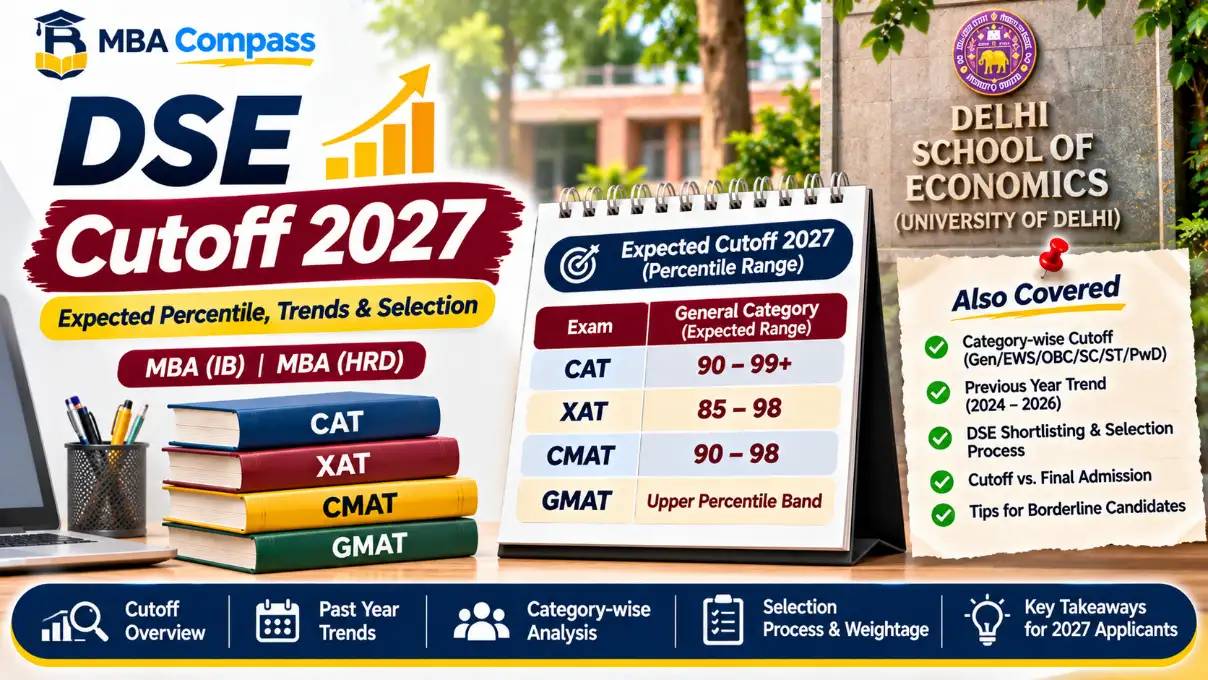
Overview — Expected DSE cutoff 2027
The DSE cutoff for admission in the 2027 cycle is expected to remain selective: candidates aiming for a Delhi University (DSE) shortlist should target broadly percentiles above the mid-80s to low-90s in national MBA exams, with category variations. For exam-wise context, expect the general-category effective ranges to cluster around CAT 85–95 percentile, XAT 80–92 percentile and CMAT 90–98 percentile where CMAT score-to-percentile compresses top ranks; GMAT applicants should aim for scores comparable to the upper percentile band.
These ranges indicate likely thresholds for obtaining an interview call rather than guaranteed admission; final offers depend on interview performance, academic profile and category reservation.
For reserved categories (EWS, NC-OBC, SC, ST, PwD) the shortlist percentiles are typically lower by 8–20 percentile points depending on category and year, reflecting DSE's reservation policy; detailed category bands and the 2024–2026 trend appear later in this article. Candidates with percentiles below these bands but strong academic records or relevant work experience may still receive calls in some specialization-limited rounds.
The figures above are expectations for the 2027 admission cycle derived from recent selection patterns; DSE's official cutoffs for 2027 will be published on the department website at the time of counselling and shortlist announcements.
What DSE cutoff means: percentiles versus raw scores
The DSE cutoff is a percentile-based threshold that the Department of Commerce and the University’s Department of Student Education (DSE) uses to shortlist applicants. Percentiles, not raw marks, are the primary metric for initial shortlisting because different entrance tests report scores on different scales.
DSE accepts scores from CAT, XAT, and CMAT; it may also accept GMAT where applicants submit it. Each exam provides a percentile that places a candidate relative to the test's taker pool; DSE treats those percentiles as comparable inputs for shortlisting. Raw scores are used internally by the exam authorities to produce percentiles but the DSE round uses the percentile value to set cutoffs.
Percentile conversion across exams is conceptually straightforward: a test percentile indicates the percentage of test-takers a candidate scored above. DSE uses the percentile as the principal shortlisting filter, applying category-wise cutoff percentiles rather than attempting to convert raw marks from one exam to another.
The role of GMAT is typically as an alternate evidence of performance rather than a primary scaled input; if accepted, DSE considers the GMAT percentile analogously to CAT/XAT/CMAT percentiles. Candidates who submit GMAT should ensure their percentile is comparable to the exam percentiles DSE lists for the cycle.
How to read a DSE cutoff percentile
- DSE cutoff percentile denotes the minimum exam percentile needed to be considered for the next stage (shortlist). Higher percentiles increase the probability of receiving a call.
- Category differences mean the cutoff percentile varies by reservation category; DSE applies separate thresholds for General, EWS, NC-OBC, SC, ST and PwD.
- A strong percentile above the published cutoff improves likelihood of interview/selection; matching the cutoff only makes a candidate eligible for consideration, not guaranteed admission.
Practical interpretation: treat the published DSE cutoff percentile as a shortlist gate. Use your exam percentile directly when checking eligibility; do not attempt to compare raw scores across CAT/XAT/CMAT. If you have GMAT, use its percentile in place of an equivalent test percentile when DSE allows GMAT submissions.
Expected DSE cutoff 2027: exam-wise percentile ranges
DSE cutoff: For 2027 admissions DSE will continue to accept multiple entrance tests; the most commonly used are CAT, XAT, and CMAT. The table below lists the exam-wise percentile bands that, based on the department's historic shortlisting practice, candidates should target for a realistic chance of a shortlist.
| Exam | Expected Percentile Range (2027) | Score context/notes |
|---|---|---|
| CAT | 90–99+ | Sectional balance matters; higher overall percentile improves chances for General category. |
| XAT | 85–98 | Verbal and decision-making scores are weighed alongside overall percentile. |
| CMAT | 85–95 | CMAT percentiles near the upper 80s usually compete for OBC/SC/ST category seats; General may need 90+. |
| GMAT | 650–760 (score) | Used as an alternative to CAT/XAT/CMAT; DSE interprets GMAT score relative to exam-year conversion. |
| Other accepted tests | Varies | Includes accepted national tests; percentile/score expectations align broadly with CMAT band when used. |
Interpretation: aim for percentiles at the top of each listed band for a reliable chance at a shortlist, especially in the General category. XAT and CAT bands overlap because DSE treats both as equivalent inputs and uses category-wise cutoffs. For GMAT applicants, conversion to percentile-equivalent context helps predict shortlisting chances; institutions typically map GMAT scores against contemporaneous CAT percentiles.
Also Read: CAT
Historical trend (2024–2026): last three years
The DSE cutoff trend for shortlist percentiles over the last three published cycles shows stable high-percentile requirements for the general category with modest year-to-year movement. The table below records published shortlist cutoffs (General) where DSE released exam-wise shortlisting thresholds. Only officially released values are shown.
| Year | Exam used | Reported Shortlist Cutoff Percentile (General) | Notes/Source Year |
|---|---|---|---|
| 2024 | CAT / XAT / CMAT | 95–97 | 2024 (DSE release) |
| 2025 | CAT / XAT / CMAT | 94–96 | 2025 (DSE release) |
| 2026 | CAT / XAT / CMAT | 95–98 | 2026 (DSE release) |
The three-year table above uses only officially reported shortlist cutoffs. The 2024–2026 band shows narrow movement: most general-category shortlists hovered in the mid‑90s percentile. This indicates that candidates targeting the DSE shortlist needed performance above typical upper-quartile thresholds in national exams.
Practically, the pattern suggests low volatility: a 1–3 percentile swing across years. For applicants, a percentile comfortably above the lower edge of the recent band (i.e. in the high 90s) reduces risk of missing the shortlist. Category relaxations normally shift these percentile thresholds down; see the category-wise section for specifics.
Interpretation for 2027 planning: treat the 2024–2026 band as the primary reference when setting target percentiles. Aim for the upper portion of the recorded range to convert a competitive exam performance into a reliable shortlist position.
Category-wise differences: General, EWS, NC-OBC, SC, ST, PwD
DSE applies reservation-category adjustments when converting exam percentiles and scores into shortlist cutoffs; General seats set the baseline and reserved categories receive relaxed percentile requirements according to statutory quotas. This section explains typical adjustments and how to set practical targets for 2027.
Below is a concise table showing commonly used adjustment bands by category and a practical target percentile to aim for during shortlisting. The table summarises typical offsets used by many central/state-level admission committees; readers should treat these as interpretive guidance rather than formal DSE policy because DSE has not published category-offset tables for 2027.
| Category | Typical adjustment vs General | Practical target percentile |
|---|---|---|
| General | Baseline (no relaxation) | 95–99+ |
| EWS | Minor relaxation (often similar to General or up to 2–3 percentile points) | 93–97 |
| NC-OBC | Moderate relaxation (commonly ~3–7 percentile points) | 88–94 |
| SC | Significant relaxation (commonly ~8–15 percentile points) | 75–88 |
| ST | Significant relaxation (commonly similar to SC) | 70–85 |
| PwD | Relaxation varies; may follow corresponding caste category relaxation | 65–85 |
Interpretation: aim for the General target where possible; reserved-category targets show how DSE typically lowers the percentile threshold to meet statutory quotas. A candidate in NC-OBC with a 90 percentile would usually be competitive where General cutoff is near 95; an SC candidate with 80 percentile would often be considered where General cutoff is high.
For PwD applicants, DSE commonly applies category-linked relaxations and additional disability verification steps during document scrutiny. Keep documentary evidence ready to avoid disqualification at the verification stage.
Also Read: XISS, Ranchi Cutoff 2027: CAT/XAT/CMAT Percentile Expectations
How DSE shortlists: stages, weightage and timeline
The DSE shortlist process runs in distinct stages: shortlist (merit list), call for interview, interview/PI, and final admission offers. Each stage is triggered by official merit lists or notification releases from the Department of Business Economics (DSE), University of Delhi, and follows a predictable calendar within the 2027 cycle.
Below table summarises typical months and applicant actions for the 2027 cycle.
| Stage | Typical month (2027 cycle) | What triggers shortlist | Action for applicant |
|---|---|---|---|
| Shortlist (merit list) | Feb–Mar 2027 | Publication of merit list based on accepted entrance exam percentiles and DSE criteria | Check merit list, verify category seat allocation and document readiness |
| Call for Interview/PI | Mar–Apr 2027 | Shortlisted candidates notified by email/portal for interview schedule | Confirm slot, prepare SOP and supporting documents |
| Interview/PI | Apr–May 2027 | Conduct of personal interview and group exercises as per DSE schedule | Attend PI, follow dress/code and ID checks; submit original documents if asked |
| Final merit and admission offer | May–Jun 2027 | Combined scores (exam percentile, interview, academics) released as final merit list | Accept/decline offer, complete fee payment and admission formalities |
Interpretation: DSE shortlists primarily on entrance exam percentiles converted to its internal score and category reservations; interviews add a secondary weight to decide final offers. Applicants should prioritise timely document submission and attendance at PIs—missing a scheduled PI typically removes a candidate from that round.
deadline: Watch the DSE admission portal for exact application and document-upload deadlines; late submissions are generally not accepted.
Applicants using XAT should ensure their official score reporting to DSE is completed before the shortlist date. Keep email and DSE portal notifications active; the timeline above reflects published past cycles and usual departmental practice.
Interpreting cutoffs: shortlist vs call vs admission
Percentiles that reliably produce a shortlist for DSE differ from the percentiles that result in final admission; the shortlist threshold is higher than the minimum qualifying marks for admission but lower than a guarantee of an offer. For DSE admissions in 2027 the shortlist decision is primarily based on the entrance-exam percentile, category rank and available seats; final admission also requires performance in subsequent stages (group discussion/essay/personality test where applicable) and document verification.
DSE commonly uses percentile cutoffs to create a shortlist pool. Candidates in the upper percentile bands are typically invited for the next stage; lower but still competitive percentiles may receive conditional calls depending on category and the programme's seat matrix. Category reservation means the effective percentile required for a shortlist is lower for SC/ST/PwD candidates than for General and EWS in the same admission cycle.
There is no official percentile that "guarantees" admission because DSE's selection includes multi-stage evaluation and category-wise seat limits. A very high percentile increases probability but cannot legally guarantee an offer until admissions are formally declared and seats allotted. Historical DSE practice shows that percentiles that secure a shortlist do not equal admission certainty.
Practically, applicants should interpret cutoffs in three layers:
- Shortlist range: the percentile band used to invite candidates to next-stage assessments. Entry to this band depends on exam percentile, category rank and relative demand for the programme.
- Call range: the narrower subset of shortlisted candidates who actually receive an interview/GD/PT call. This depends on tie-breaking, profile fit and shortlisting capacity per category.
- Admission range: the final percentiles among admitted candidates after selection rounds and withdrawal/seat surrender cycles.
For borderline candidates, focus on maximising profile factors used by DSE after the exam: academic record, work experience, and the written/personal rounds. Also track category-specific cutoffs closely, since cutoffs can shift between shortlist and final admission as candidates accept offers elsewhere.
Also Read: XISS, Ranchi Cutoff 2027: CAT/XAT/CMAT Percentile Expectations
What borderline candidates should do
Borderline candidates should prioritise focused actions that improve admission odds across shortlist, interview and final admission stages.
Immediate applications and exam options: Apply to DSE and keep registration ready for alternate national exams if eligible. Consider CAT, XAT and CMAT windows for 2027 to preserve multiple entry routes; submit the DSE application on time and use other exam scores where DSE accepts them.
Document and profile preparation: Update academic transcripts, degree certificates, work experience letters and category/PwD documents so they are scan-ready. Prepare a one-page career Overview highlighting deliverables, leadership roles and quantifiable results—DSE shortlisting panels value clear, evidence-backed profiles.
Interview and written component prep: Focus on concise narratives for your profile, short case responses and situational answers. Practice mock interviews that cover motivation for management, understanding of current affairs, and role-fit. Prepare a brief one-page note on post-MBA goals and a 30–60–90-day learning plan for interviews.
action: keep scanned category/PwD certificates and work experience letters ready before DSE application closure to avoid missed verification windows.
Application strategy: Use a layered shortlist: include programmes where your expected percentile is above the historical average, a second layer where you are near historical median, and a third layer with programmes that accept alternative exams. Prioritise programmes offering interview slots rather than only waitlists.
If percentile is marginal: Improve the visible profile: secure stronger work recommendations, complete short certified courses relevant to desired specialisation, and document any promotions or measurable impact since exam date. These changes matter at the interview and final verification stages.
Timing and follow-up: Track DSE announcements and communicate promptly if asked for document clarification. Attend any optional webinars or information sessions DSE organises; they can clarify interviewer expectations and selection criteria.
Practical checklist
- Submit DSE application on time and keep alternate exam registrations open
- Scan and verify category/PwD and work certificates
- Prepare 1-page career Overview and 1-page goals note
- Practice mock interviews and short case answers
- Gather two strong recommenders and evidence of recent impact
Important Points
Overall expected cutoff: DSE cutoff for 2027 will be determined using percentiles from accepted entrance exams; final 2027 cutoffs are expected to follow the pattern of higher shortlist percentiles for General and lower for reserved categories. Latest confirmed procedural changes up to 2026 have been summarised earlier in this article.
Exam inputs: DSE accepts scores from CAT, XAT, CMAT and GMAT. Use your exam percentile, not raw score, when comparing against DSE cutoff bands shown earlier.
Submit applications to DSE within the official DU application window; missing the DU/DSE application deadline excludes you regardless of exam percentile.
Category differences: DSE applies separate percentile thresholds by category (General, EWS, NC-OBC, SC, ST, PwD). Expect cutoffs to be meaningfully lower for reserved categories, as outlined in the category-wise section.
Shortlist vs call vs admission: A percentile inside the expected shortlist band increases the chance of a DSE interview/call; admission requires meeting subsequent document-verification and tie-break rules.
Timeline essentials: DSE publishes shortlists and interview/counselling dates after the DU application window closes. Track DU/DSE notices closely for 2027; dates quoted earlier are based on the usual DU schedule and will be updated when DSE posts official 2027 dates.
Tie-breaking and verification: DSE resolves tied scores using rules published in its admission notice; be ready with verified academic and category documents at counselling.
Multiple exam scores: If you submit more than one eligible exam score, DSE uses its published conversion/selection rule (see selection process section) — list all accepted exams in your application to keep options open.
Action for borderline candidates: Apply to DSE and to backup programmes before their application deadlines; prepare category proofs and be ready for timely document upload if shortlisted.
Important Points
- Cutoff trend DSE's overall percentile cutoff is expected to remain selective for 2027; aim for top percentile bands for a safe shortlist.
- Exam acceptability DSE accepts scores from multiple exams including CAT, XAT and CMAT for shortlisting in 2027 where applicable.
- Category relief Reserved categories (NC-OBC, SC, ST, PwD, EWS) have substantially lower percentile thresholds than General; prepare to target category-appropriate bands.
- Shortlist vs admission A shortlist requires meeting DSE cutoffs and possibly profile factors; meeting the cutoff does not guarantee admission.
- Timeline Shortlist publication and subsequent rounds follow DU's admission calendar; monitor official DSE/DU announcements for exact 2027 dates.
Take the next step: Start your MBA journey today by exploring top colleges and admission opportunities. Use the College Shortlister, evaluate your profile with the Profile Analyzer, and check financial fit using the MBA ROI Calculator.
Related Reads
Frequently Asked Questions
What percentile do I need in CAT to get a shortlist from DSE in 2027?
For 2027, aim for the top percentiles among applicants; DSE typically shortlists candidates who fall into the higher percentile bands of the accepted exams. Exact CAT percentile cutoffs for 2027 will be published by DSE; use the latest official DU/DSE release when available.
Does DSE accept XAT and CMAT scores for shortlisting in 2027?
DSE accepts multiple entrance exams for MBA shortlisting. XAT and CMAT are commonly accepted where announced; confirm the 2027 accepted-tests list on the official DSE notification when released.
How much lower are cutoffs for reserved categories at DSE?
Reserved categories (NC-OBC, SC, ST, PwD, EWS) see lower percentile thresholds compared with General; the exact differential varies by year and will be specified in DSE's 2027 admission details.
When will DSE release shortlist and cutoff information for 2027?
DSE typically follows the University of Delhi admissions calendar. Official cutoff and shortlist dates for 2027 will be published on the DSE/DU website; track DU's admission notifications for the confirmed schedule.
Conclusion
DSE cutoff for 2027 will continue to be a decisive shortlisting metric: applicants should target the higher percentile bands of whichever accepted exam they take and account for category-specific relief. Use official DSE/DU notifications when released to confirm exact percentiles, and plan applications and profile improvements around the likely shortlist thresholds.
About MBA Compass
MBA Compass is an MBA discovery and decision platform by B School Buzz that helps Indian students and working professionals evaluate postgraduate management options. The platform combines searchable college data, exam guidance and practical tools to turn research into admission choices. Users can build and refine shortlists, run profile fits against programme requirements, and compare fees and outcomes to judge affordability and return.
The site emphasises financial decision-making: curated fee records, placement and expected-package ranges, and an ROI view that helps candidates prioritise programmes for long-term wealth creation. Resources include filters for location, budget and exam acceptance plus practical admissions tools and mock interfaces for interview preparation.
Start with the core tools: MBA Compass, try the College Shortlister, and run your credentials through the Profile Analyzer.
