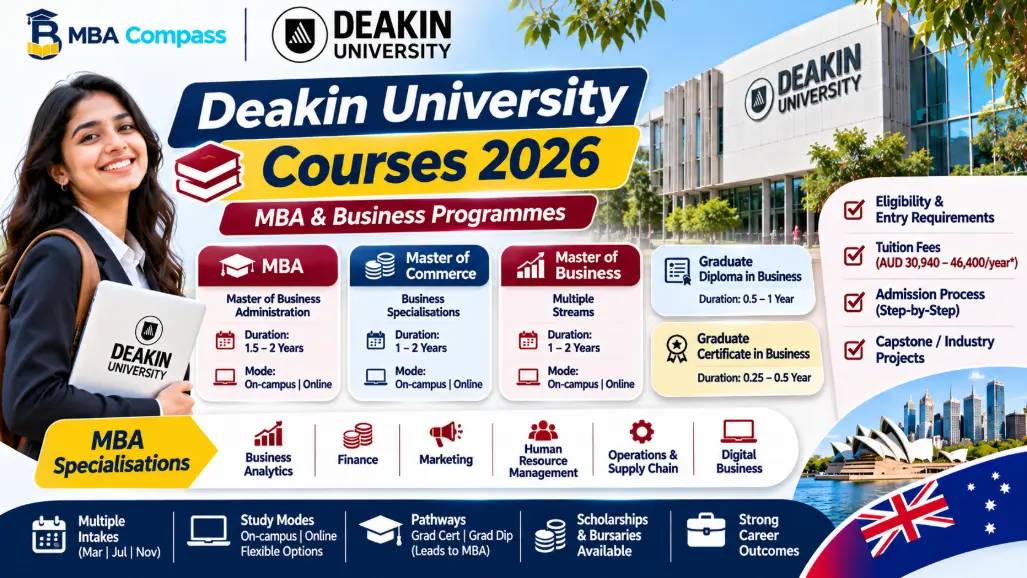
Program list: Deakin MBA and related business degrees (2026)
Deakin University offers an MBA plus a set of master's-level and postgraduate business credentials designed for different career stages and delivery preferences. Below is a definitive list of Deakin's business awards (programme names and award types), followed by a brief interpretation for applicants.
| Program name | Award type | Mode | Typical duration |
|---|---|---|---|
| Master of Business Administration (MBA) | MBA | On-campus; Online (Cloud) | 1.5–2 years full-time; flexible part-time/online options |
| Master of Commerce (MCom) — Business specialisations | Master | On-campus; Online | 1–2 years full-time |
| Master of Business (various streams) | Master | On-campus; Online | 1–2 years full-time |
| Graduate Diploma in Business | Grad Dip | Online; On-campus | 0.5–1 year full-time |
| Graduate Certificate in Business (and specialised Grad Certs) | Grad Cert | Online; On-campus | 0.25–0.5 year full-time |
Interpretation: the MBA is Deakin's flagship professional award; the Master of Business and Master of Commerce provide specialised academic-professional pathways. Graduate Certificates and Diplomas are shorter, credit-bearing credentials that commonly articulate into master's or MBA enrolment and suit working professionals seeking upskilling.
For 2026 intake details and stepwise application guidance see the Deakin admissions pages: Deakin admission and Deakin University application form.
Specialisations and electives available in each program (2026)
Deakin University offers a range of streams and majors across its MBA and related postgraduate business programs, allowing students to tailor study to functional areas or industry sectors. The table below summarises the commonly available specialisations and the typical capstone or project options linked to each program.
| Program | Available specialisations/majors | Capstone/project options |
|---|---|---|
| Deakin MBA | Business Analytics; Finance; Marketing; Human Resource Management; Operations & Supply Chain; Digital Business (Note: availability may vary by intake) | Applied consulting project; Research project; Industry capstone with external partner |
| Master of Business (specialisations) | Accounting; Finance; Marketing; Management; International Business; Economics | Research thesis or professional project; industry-based project |
| Master of Marketing | Digital Marketing; Brand Management; Consumer Behaviour | Marketing capstone project; industry placement project |
| Master of Finance | Corporate Finance; Financial Markets; Investment Analysis | Research project; professional portfolio |
Students commonly combine core coursework with elective units to build depth in a particular domain; electives may include contemporary topics such as fintech analytics, strategic human resource planning, supply chain analytics, or digital strategy, depending on program delivery and campus. Capstone options typically require either a supervised research thesis, a professional project completed with an industry partner, or an applied consulting engagement. These choices support practical learning and employer-facing outcomes.
Also Read: Deakin University admission 2027: Eligibility, Process & Dates
Duration & modes: full-time, part-time, online options
Deakin University MBA and related postgraduate business programs are offered with multiple study modes; durations depend on the specific award and mode. Below table summarises the commonly available modes and expected lengths for each program type.
| Program | Full-time duration | Part-time duration | Online duration |
|---|---|---|---|
| Master of Business Administration (MBA) | 1.5–2 years (accelerated/full-time on-campus) | 2–3 years (part-time on-campus or blended) | 1.5–3 years (Deakin Cloud Campus MBA flexible pace) |
| Master of Business (specialisations) | 1.5–2 years | 2–4 years | 1–3 years |
| Graduate Certificate / Graduate Diploma (pathways) | 6 months–1 year | 1–2 years | 6 months–2 years |
Interpretation: the on-campus full-time MBA typically completes within 1.5–2 years depending on unit load. Part-time enrolment extends study to roughly 2–3 years for the MBA while online students using Deakin's Cloud Campus can progress at a flexible pace and finish as quickly as 1.5 years or take up to 3 years to accommodate work commitments. Graduate certificates and diplomas used as pathways have shorter durations and can be stacked into longer awards.
Students should confirm exact unit counts and maximum candidature periods on Deakin's official course pages when planning; mode choice affects assessment scheduling, internship opportunities and visa eligibility for international students.
Eligibility & entry requirements (academic, work experience, English)
Deakin University requires an undergraduate degree plus specific work‑experience and English language credentials depending on the postgraduate business program. Entry rules vary by course and mode (on‑campus vs online); the table below summarises the typical minima for Deakin's MBA and related master's business programs in 2026 where official course pages state requirements.
| Program | Minimum qualification | Work experience required | English requirements |
|---|---|---|---|
| Deakin MBA (Master of Business Administration) | Bachelor degree or equivalent | Professional work experience usually expected (varies by intake) | IELTS 6.5 overall (typical) or equivalent |
| Master of Business (MBus) / specialised Masters (e.g., Marketing, Finance) | Bachelor degree or equivalent | No minimum for some coursework Master’s; professional experience recommended for advanced streams | IELTS 6.5 overall or equivalent |
| Graduate Certificate / Graduate Diploma (pathway) | Bachelor degree or equivalent; some pathway intakes accept lower qualifications | Not required (pathway designed for early-career applicants) | IELTS 6.5 overall or equivalent (may be lower for some domestic applicants) |
Practical interpretation: a completed bachelor’s degree is the universal academic baseline. The Deakin MBA typically expects applicants to have prior professional experience; specialised Master’s programs commonly admit recent graduates with strong academic records. English-language proof (commonly IELTS 6.5 overall or accepted equivalents such as PTE/TOEFL) applies to international applicants unless exempt through prior study in English; exact score bands and exemptions are listed on the course admission pages.
Applicants who lack the standard English score or academic prerequisites can use Deakin’s Graduate Certificate pathways or approved English programs to build eligibility. For precise, course‑level entry rules and documentation requirements (transcripts, resume, personal statement, referee details) see Deakin’s admissions guidance.
eligibility: Applicants should check the specific course page for up‑to‑date work‑experience and English-band requirements; some professional pathways and online intakes have different criteria.
Also Read: Deakin University admission 2027: Eligibility, Process & Dates
Fees & fee notes (domestic and international)
Deakin University publishes program tuition details on its official pages; below we summarise the structure and the points applicants should expect when budgeting for 2026 programs.
The verified source set for this article did not include Deakin's official fee table for 2026. Because current, program-specific tuition figures must be published to be reported here, the table below is omitted to avoid unsupported numbers. Instead, the notes below explain how Deakin presents fees, what components to include, and when figures are normally released.
- Tuition components: Deakin separates tuition fees from student services and amenities charges and any compulsory campus or course materials fees.
- Domestic vs international: Domestic (Australian) student fees are commonly lower or subsidised; international tuition is higher and displayed per annum or per unit. Exact 2026 amounts are published on Deakin's course pages when available.
- Delivery mode affects fees: On-campus, cloud (online) and blended modes may carry different fee schedules. Deakin lists mode-specific fees on each program page.
- When figures are published: Deakin typically updates tuition and associated charges ahead of an intake; official 2026 fee schedules should be checked on Deakin's site after each program's 2026 fee release.
- Payment structure: Fees are payable per trimester/semester or per unit; international students must usually show financial capacity for their first year during visa processing.
- Scholarships and reductions: Scholarships, early-bird discounts or alumni reductions can affect net tuition; application and eligibility rules are specified with each scholarship.
Interpretation: Prospective domestic and international applicants should use Deakin's official course pages for final 2026 tuition figures and allow for living costs, OSHC (for international students) and incidental fees when budgeting.
update: Deakin's 2026 program tuition details are expected on official course pages; consult the university's site for published 2026 fees before applying.
Intakes, deadlines and application schedule for 2026
Deakin University runs multiple intakes and rolling application windows across its MBA and related postgraduate business programs; applicants should apply early for the intake they prefer. The main intake pattern for 2026 programmes is described below, followed by practical notes on timing and steps.
| Program | Main intake months | Application deadline notes |
|---|---|---|
| Master of Business Administration (MBA) | March, July (Cloud / on-campus options) | Applications are assessed on a rolling basis; applicants are advised to submit at least 6–8 weeks before preferred start month. See application portal details. |
| Master of Business (specialisations) | March, July | Rolling admissions; domestic and international applicants should allow additional processing time for visa documentation where applicable. |
| Graduate Certificate and Graduate Diploma (pathway programs) | February, July, November | Intakes vary by campus and online delivery; apply early to secure pathway entry into 2026 postgraduate programs. |
Applicants targeting a March or July 2026 start should prepare transcripts, CV, references and English-test evidence well in advance. International applicants must factor visa processing into their timeline and lodge applications earlier than domestic applicants.
deadline: For March and July 2026 starts, aim to submit a complete application at least 6–8 weeks before your intended intake to allow assessment and visa processing.
How to apply: step-by-step and required documents
Deakin University offers an online application process for its MBA and related postgraduate business programs. Follow these steps and gather the listed documents to complete a standard application for the 2026 intake.
Step-by-step application process
- Prepare documents: collect academic transcripts, degree certificates, CV, evidence of English proficiency, passport copy (international applicants), and two professional references or referee contact details.
- Create an account on Deakin's application portal and complete the online form for the chosen program.
- Upload documents: attach transcripts, CV, English test scores or evidence of exemption, reference contacts, and a personal statement or statement of purpose if the program requests one.
- Pay the application fee (if applicable) and submit the form. Keep the application ID for future reference.
- Assessment: admissions will verify academic credentials, check English requirements and review work experience for programs that require it. Selected applicants may be invited to an interview (online or on-campus) or asked for additional documents.
- Offer & enrolment: successful applicants receive a letter of offer with conditions; accept the offer, meet any conditions (e.g., final transcripts), and follow enrolment instructions including fee payment and orientation registration.
Required documents checklist
- Academic transcripts and degree certificate (official, in English).
- Curriculum vitae / resume detailing work history.
- Proof of identity (passport for international applicants; national ID where applicable).
- Evidence of English proficiency (IELTS/TOEFL/PTE scores) or documented exemption.
- Referee details or reference letters (two recommended for many postgraduate business programs).
- Statement of purpose / personal statement if requested by the program.
- Work experience evidence (employer letters) where the program has experience requirements.
ACTION REQUIRED: International applicants must allow extra time for visa documentation and for certified translations of documents where necessary.
For program-specific application pages and online submission steps, use Deakin's official apply portal and detailed guidance at Deakin University Application Form 2027: Apply Online, Applicatio.
Pathways & Grad Cert/Dip options leading to MBA
Deakin University supports stackable postgraduate credentials that let students begin with shorter awards and progress into a full master's or MBA. These pathways are designed for students who need an incremental route—upskilling through a graduate certificate or diploma before moving to an MBA-level qualification.
Below is a concise table of typical stackable pathways and progression routes offered by Deakin. Each row shows the short award, its usual duration and the higher degree it articulates into.
| Pathway | Duration | Progression to which program |
|---|---|---|
| Graduate Certificate in Business | ~6 months (part-time/online) | Master of Business Administration / Master of Business |
| Graduate Diploma in Business | ~12 months (part-time/online) | Master of Business Administration / Master of Business |
| Graduate Certificate in Management | ~6 months (online) | Master of Business Administration |
Students who complete a Deakin graduate certificate or diploma can usually apply for credit into a related master's program; the amount of credit and direct entry rules depend on the specific subjects completed and the target degree's admission policy. Progression commonly requires meeting the master's academic and English requirements and lodging an internal progression application through Deakin's admissions portal.
Stacking credentials suits professionals seeking immediate upskilling and a lower-cost entry point to a master's. Graduates of Deakin graduate certificates often continue part-time or online into higher degrees without repeating covered core units.
Also Read: Deakin University admission 2027: Eligibility, Process & Dates
Scholarships, bursaries and fee assistance for MBA students
Deakin University offers a mixture of scholarships, bursaries and targeted fee-assistance for postgraduate business students; eligibility and application rules vary by award. Below is a concise table of prominent scholarship types that Deakin makes available to MBA and related postgraduate business candidates, followed by practical guidance on combining awards and applying.
| Scholarship/Bursary | Eligibility | Value/benefit | How to apply |
|---|---|---|---|
| Deakin Vice-Chancellor's International Scholarship | High-achieving international students (academic merit) | Partial tuition scholarships for eligible programs | Apply via Deakin course application; selection on academic evidence |
| Deakin Business School scholarships | Domestic and international postgraduate business students meeting merit or equity criteria | Fee reduction or stipend awards (varies by scholarship) | Apply through Deakin Scholarship Portal or indicate interest on course application |
| Faculty and departmental bursaries | Students with demonstrated financial need or special circumstances | One-off payments or fee concessions | Contact Deakin Business School student services; submit supporting documents |
| External industry scholarships | Candidates meeting sponsor-specific criteria (e.g., sector background) | Varies — can include tuition support or internships | Apply to the sponsoring organisation; disclose award in Deakin application |
Practical interpretation: students should list scholarships on their Deakin application and on the Deakin Scholarship Portal; some awards require a separate application while others use merit identified during admissions. Awards often cannot be combined with other institutional tuition discounts — confirm terms in the scholarship conditions. Documentary evidence typically required includes academic transcripts, a CV, a personal statement and proof of financial need when applicable.
Also Read: Deakin University Application Form 2027: Apply Online, Application
Careers and outcomes: roles, industries and placement notes
Deakin University MBA and related postgraduate business graduates commonly move into managerial and specialist roles across corporate, government and start-up sectors; employment outcomes reflect program mode (on-campus or cloud) and prior work experience.
The table below summarises typical graduate roles, industries and work-integrated learning opportunities available through Deakin's business programs.
| Program | Common graduate roles | Industries | Work-integrated learning options |
|---|---|---|---|
| Deakin MBA (Master of Business Administration) | General management, project manager, product manager, consultant, operations manager | Financial services, consulting, technology, healthcare, government | Industry projects, internships, practicum units, corporate capstone projects |
| Master of Business (specialist streams) | Business analyst, specialist manager, finance manager, marketing manager | Professional services, marketing, finance, supply chain | Industry-aligned electives, internship units, research placements |
| Graduate Certificate/Diploma (pathway programs) | Analyst roles, entry-level management, project coordinator | Various sectors depending on specialisation | Short industry projects, workplace assessments, credit transfer into Masters |
Deakin Business School embeds work-integrated learning across its postgraduate business courses: capstone projects, industry-led case studies and optional internships connect students with employers and real problems. Cloud (online) students access industry projects and virtual practicums; on-campus cohorts benefit from local employer networks in Melbourne and Geelong. Graduates with prior work experience commonly target senior or cross-functional roles; early-career entrants typically accept analyst or coordinator positions before progressing to management.
Also Read: Deakin University admission 2027: Eligibility, Process & Dates
Rankings, recognition and accreditation (brief)
Deakin University holds recognised Australian university status and its business teaching is delivered through Deakin Business School, which operates under national higher-education regulation. The university and its business school are accredited and registered with Australian educational authorities; these recognitions confirm degree validity for domestic and international students seeking recognised postgraduate business qualifications.
International and subject rankings and professional accreditations fluctuate by year and should be checked on Deakin's official pages for the 2026 cycle. Where published accrediting bodies are cited by Deakin, they typically include national registration and program-level recognitions that support international student visa and qualification frameworks.
Below is a concise factual Overview you can use as a starting point; it lists the categories of recognition relevant to prospective MBA/PG business students. Specific ranking positions and recent award years are not included here because current-year ranking evidence for 2026 must be confirmed on Deakin's official rankings pages or recognized ranking publishers with publication dates within 60 days.
| Recognition / Accreditation | What it means for students |
|---|---|
| Australian University Registration | Degrees meet national standards; eligible for domestic student support and recognised for Australian credentials. |
| Deakin Business School | School-level authority within Deakin that manages MBA and business programs and outcomes. |
Interpretation: Deakin's formal recognitions confirm that MBA and related business awards are legitimate Australian qualifications suitable for employment credentialing and further study. Prospective applicants should verify any international ranking positions, professional accreditations (such as AACSB, EQUIS or AMBA) and the latest Deakin Business School statements on the official website when finalising choices for the 2026 intake.
Important Points
- Program mix Deakin offers the Master of Business Administration and related postgraduate business degrees across on-campus and online modes.
- Mode flexibility Deakin’s online MBA options allow part-time study with staggered intakes and self-paced units.
- Eligibility Applicants need a recognised undergraduate degree; work experience requirements vary by program and some streams prefer or require relevant professional experience.
- Fees Domestic and international tuition differs; check Deakin’s official pages for 2026 figures before applying.
- Accreditation Deakin Business School holds national Australian accreditation and international recognition; check program pages for details.
Take the next step: Start your MBA journey today by exploring suitable colleges with the College Shortlister, checking your fit using the Profile Analyzer, and estimating outcomes with the MBA ROI Calculator.
Similar Colleges to Check
Compare these colleges alongside Deakin University Courses & Programs before you finalise your shortlist.
| College | What to compare |
|---|---|
| IIT Bhilai (MBA) | Fees, cut-offs and placements |
| IIT Dharwad (MBA) | Fees, cut-offs and placements |
| IIT Gandhinagar (MBA) | Fees, cut-offs and placements |
| IIT Gandhinagar (MBA) | Fees, cut-offs and placements |
| IIT Indore (MBA) | Fees, cut-offs and placements |
| IIT Indore (MBA) | Fees, cut-offs and placements |
| IIT Palakkad (MBA) | Fees, cut-offs and placements |
| IIT Tirupati (MBA) | Fees, cut-offs and placements |
Related Reads
Frequently Asked Questions
What MBA and postgraduate business degrees does Deakin University offer in 2026?
Deakin offers the Master of Business Administration alongside related postgraduate business degrees such as specialised Master of Commerce and Master of Business programs delivered on-campus and online.
What are the eligibility and English language requirements for Deakin MBA programs?
Eligibility requires a recognised bachelor’s degree; work experience requirements vary by program. English language proficiency typically requires IELTS/TOEFL or equivalent unless exempted by prior study in English.
How much does a Deakin MBA cost for international students in 2026?
International tuition varies by program and mode; check Deakin’s official international fee pages for 2026 figures as this article uses latest published data on Deakin’s site.
Can I start an MBA at Deakin online and transfer to on-campus study later?
Deakin offers pathway and articulation options; transfer between modes depends on unit compatibility and approval from the faculty. Confirm with admissions on the specific program planning.
What documents are required when applying to Deakin's MBA?
Standard documents include academic transcripts, resume, statement of purpose, proof of English proficiency, referees’ details and any required test scores such as GMAT if requested.
Conclusion
Deakin University provides a mix of MBA and related postgraduate business degrees delivered across on-campus, hybrid and online modes with flexible durations and entry pathways. Prospective applicants should confirm specific 2026 fees, intake dates and any work-experience requirements on Deakin’s official program pages before applying, and use available articulation and scholarship options to manage cost and study mode.
About MBA Compass
MBA Compass is an MBA discovery and decision platform built by B School Buzz to help Indian students and working professionals make informed postgraduate management choices. The platform provides tools to shortlist colleges, compare programmes on fees and outcomes, analyse individual profiles for realistic admission chances and run mock assessments that mirror common entrance patterns.
MBA Compass focuses on the financial decision: it estimates total programme costs, projects return on investment using placement bands and offers calculators to weigh long-term wealth outcomes versus tuition and living expenses. The site aims to reduce application risk for prospective candidates by combining practical admissions benchmarks with fee and ROI analysis.
Also Read: MBA Compass College Shortlister Profile Analyzer
