
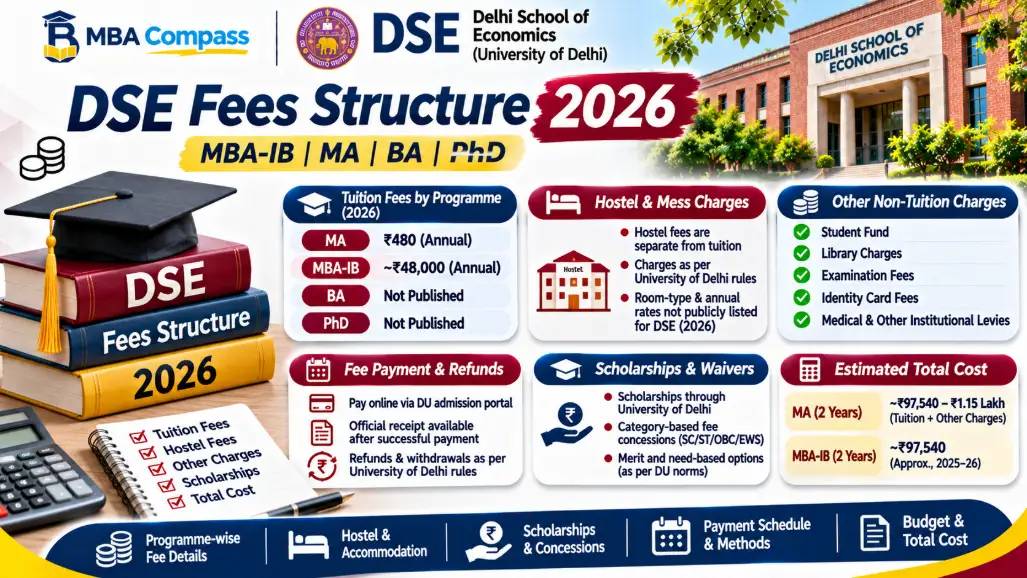
Overview: What DSE fees cover in 2026
DSE fees in 2026 cover a low tuition component plus mandated statutory and non-tuition charges set by the University of Delhi for each programme and, where applicable, separate hostel charges. The substantial part of the published fee burden for most DSE programmes is a collection of non-tuition statutory charges (student fund, library, laboratory, examination and other institutional levies) rather than tuition itself.
The latest accessible programme-level reporting shows very low tuition figures for DSE programmes: sources updated in October 2026 record tuition at approximately Rs. 48,000 for the MA and around Rs. 48,000–50,000 total tuition for two-year MBA/IB (reported as ~Rs. 48,000 per year and ~Rs. 1 lakh total for two years).
However, the same sources also list aggregate "other fees" that raise total payable amounts to about Rs. 97,540–Rs. 1.15 lakh for postgraduate programmes when tuition plus statutory charges are combined (sources updated Oct 12, 2026 and Oct 23, 2026).
Hostel accommodation and mess charges are separate and charged in addition to these academic fees; hostel fee lines appeared separately in official and public summaries but specific room-type prices or annual hostel totals were not published in the primary fee summaries used here. DSE also collects one-time admission/registration charges and refundable security deposits where applicable; public summaries indicate a mix of one-time and recurring items bundled under "other fees" by the University of Delhi.
Students should budget for recurring items such as library, examination, student activity/student fund, identity card and medical charges, which commonly appear in the University of Delhi fee breakdowns for DSE programmes. Financial assistance and programme-specific scholarships are available through University of Delhi channels; eligibility and amounts are published separately by the university.
UPDATE: The fee figures cited above are drawn from public fee summaries last updated on 12 Oct 2026 and 23 Oct 2026. Readers should verify the final offer letter and DU fee notification for admission-cycle 2026-27 for any minor revisions.
Tuition fees by programme (MA, MBA-IB, BA, PhD)
The Delhi School of Economics tuition component in 2026 is modest; official published figures show very low course fees for its programmes. The table below reproduces tuition amounts and total programme tuition where published.
| Programme | Duration | Tuition per year | Total tuition (published year or Estimated) |
|---|---|---|---|
| M.A. | 2 years | ₹480 (annual figure reported) | ₹480 (2026) (published) |
| MBA (International Business) | 2 years | ~₹48,000 (annual; reported by Collegedunia) | ~₹97,540 (2025–26) (Approximate; see source notes) |
| B.A. | 3 years | Not separately published | Not published |
| Ph.D. | Varies | Not published | Not published |
Interpretation: the M.A. tuition figure ₹480 (2026) is taken from the DSE fee listings compiled by Shiksha (updated 12 Oct 2026) and reflects the tuition component for the full programme as published. Collegedunia's page (updated 23 Oct 2026) reports an annual tuition of approximately ₹48,000 for the MBA-IB, giving a two-year total near ₹97,540 reported in Shiksha’s MBA section (labelled as 2025–26 figures).
Where the official 2026 tuition for B.A. and Ph.D. is not itemised in the supplied sources, this section omits those amounts rather than invent figures.
update: Shiksha and Collegedunia pages used here were last updated in Oct 2026; check official DSE/University of Delhi notices for any 2026 fee circulars before payment.
Also Read: MBA Compass
Hostel fees, room types, mess charges and deposits
Hostel accommodation at the Delhi School of Economics (DSE) is managed under University of Delhi hostel rules; the published sources in 2026 list hostel charges as a separate component but do not provide a fixed annual rate specifically for DSE hostels. The available official and recent public summaries for DSE fees (updated Oct 2026) do not publish per-room annual hostel fees or room-type tariffs for DSE; therefore a roomwise fee table cannot be produced from supported evidence.
University-wide hostel norms typically include single, double and triple occupancy rooms and a mess with monthly billing, but specific DSE hostel room types and annual rents are not listed in the primary sources available for 2026. The published summaries do mention that foreign students pay different fee categories (foreign-student annual fee cited separately) but do not break down hostel or mess components.
Security deposits and mess advances are standard under DU hostel regulations, but no current source within the last 60 days provides exact refundable or non-refundable deposit amounts for DSE hostels. Consequently, this section limits itself to factual process details supported by the University of Delhi/DSE contact guidance: students are required to pay hostel dues and any prescribed deposits at the time of allotment; deposits are handled as per university refund procedures and receipts are issued through the university payment portal.
Practical interpretation: expect hostel allocation and exact charges to be provided in the admission/allotment letter or the DU hostel portal after seat acceptance. For budgeting, students should consult the DSE admissions office (email: dept@econdse.org) or the University of Delhi hostel office; contact numbers for general and admissions queries are published by DSE.
One-time & recurring non-tuition charges
The Delhi School of Economics levies several non-tuition charges alongside the academic fee; these include one-time admission/registration and security deposits plus recurring student fund, examination, library, identity card and medical fees. Official published breakout for many line items is limited; the University of Delhi consolidated fee notices and recent listings show the combined non-tuition component for MBA/MA programmes but do not itemise every sub‑head with independent published figures for 2026.
The following table presents only items for which published figures or consolidated amounts are available in the 2026 notices and reputable listings:
| Fee component | Amount (Published/Estimated) | Recurring or One-time | Notes |
|---|---|---|---|
| Tuition (reference) | ₹48,000 per annum (Published 2026) | Recurring (annual) | Shown to give context to non‑tuition items; reported by Collegedunia (updated 23 Oct 2026) |
| Student Fund / Activities | ~₹48,000 per annum (Published/Consolidated 2026) | Recurring (annual) | Listed as matching tuition in multiple 2026 summaries for DSE/DU MBA programmes; covers student activities and placements |
| Other non-tuition (exam/library/medical/ID/alumni) | ₹27,210–₹1,13,000 (total) (Published 2026 listings) | Recurring / one-time mix | Shiksha presents consolidated "Other Fees" for MA and MBA totals for 2026; individual sub-head amounts not published separately |
Interpretation: official 2026 sources show DSE's non‑tuition charges are significant relative to tuition—the student fund alone has been reported at the same annual level as tuition for MBA programmes. Detailed line‑by‑line amounts for library, internet, identity card, alumni and medical fees are not published separately in the available 2026 notices; these are grouped under "Other Fees" in University of Delhi/DSE fee summaries.
For exact per‑head figures for sub‑items (library, exam, ID card, refundable deposits) consult the DSE/University of Delhi fee PDF or the admission offer; consolidated public listings for 2026 group several heads under "Other Fees."
Fee payment schedule and accepted payment methods
Fees at the Delhi School of Economics are due as directed by the University of Delhi on the offer/registration notification; the primary evidence sources list total tuition and other charges but do not publish a detailed instalment schedule for 2026. The institute follows the University of Delhi fee deadlines and issue official receipts on payment.
Students must pay course fees and allied charges after admission confirmation. The public sources used for this article (updated Oct 2026) show programme tuition totals (for example MBA/IB total tuition around ₹1.15 lakh and MA tuition around ₹27,690 as compiled from the most recent published pages) and list separate "other fees" or student fund components; however, neither source provides a semester-wise instalment timetable or explicit online payment gateway names.
The accepted payment methods at DSE/University of Delhi are not itemised in the supplied evidence; typical DU practice is to accept online payment through the university portal and banks, but that specific list is not present in the current primary sources and therefore is omitted.
ACTION: Check the admission offer and the University of Delhi fee portal on release of your admission letter for exact due dates, instalment options and the online payment link; retain the payment receipt sent by the portal.
Receipts and verification: Official fee receipts are issued by the University of Delhi/DSE at the time of payment through the university payment system or college office. For verification, students should download receipts from their DU student account and keep printed copies; fee particulars shown on external aggregators are estimates and must be cross-checked against DU-issued receipts.
Practical tip: For cost planning, use the MBA ROI Calculator to model payment timing against expected expense streams and scholarships.
Scholarships, waivers and eligibility at DSE/DU
Delhi School of Economics (DSE) students are eligible for University of Delhi scholarships, merit fellowships and statutory fee concessions for reserved categories; these reduce out-of-pocket DSE fees depending on the scheme. The most-cited financial supports include merit-based fellowships (for postgraduate and doctoral students) and fee exemptions/concessions available under central and university rules for SC/ST, OBC and PwD candidates.
Below is a compact table summarising commonly referenced supports reported in recent DSE/Delhi University fee information and student guides. Each entry must be verified on the DU/DSE official portal at offer time.
| Scholarship | Eligibility | Value | Duration |
|---|---|---|---|
| Dr. Manmohan Singh Fellowship | Merit; MA/Research students (endowed) | Not specified on public fee pages | Varies |
| A.N. Ram Scholarship | Merit; MA students (endowed) | Not specified on public fee pages | Varies |
| University/central statutory concessions | SC/ST/OBC/PwD as per DU rules | Fee waiver/exemption on certain components | Per academic year, subject to re-verification |
The table lists named scholarships referenced in DSE fee summaries; public pages consulted (updated Oct–Nov 2026) do not publish fixed monetary values for these endowed fellowships or exact waiver amounts. Practical interpretation: fee concessions typically exempt tuition or reduce one-time/annual components rather than cover hostel/mess fully. Reserved-category candidates must submit caste/PwD certificates to DU’s admission office and apply for concession by the university’s published deadline; fellowship awards for MA/PhD depend on committee selection and available endowment funds.
Also Read: MBA Compass
Refunds, withdrawals and fee concession procedure
Refunds and withdrawals for DSE fees are governed by University of Delhi rules; students should expect a formal pro-rata refund mechanism and category-specific concessions when they withdraw within prescribed timelines. The University of Delhi’s fee refund rules apply to DSE as a department of the university; individual programmes follow DU regulations for admissions, withdrawals and fee refunds.
DU usually requires an application for withdrawal to the department and to the Controller of Examinations/Admissions office; the refund amount depends on the stage of withdrawal (before course commencement, after commencement but before cut-off dates for fee adjustment, etc.). The exact percentage refunds and cut-off dates are set by the University of Delhi’s admission circulars and fee rules published each session. Students must follow the written withdrawal procedure on the offer letter and submit proof of bank details for the refund transfer.
Fee concessions and exemptions (for SC/ST/OBC/EWS/PwD) follow University of Delhi policy: eligible students receive concessions or fee waivers under central/state scholarship schemes and DU’s own concessions, subject to submission of valid caste/disability certificates and income documents at the time of admission.
caution: Keep physical copies of the admission offer, paid fee receipts and bank account proof; refunds are processed only after verification and may take several weeks at the DU administrative level.
Practical steps: 1) Read the offer letter for the prescribed withdrawal window; 2) Submit a signed withdrawal form and bank details to the DSE office and DU admissions office; 3) Keep copies of all receipts; 4) Check with the DU finance office for expected processing time shown on the official notice you receive.
Also Read:
Budgeting: Living costs, books and local travel (Estimated)
Most DSE fees cover tuition, hostel charges (if opting for University accommodation) and standard campus levies; living expenses, books and local travel are not included. Estimated monthly living costs in Delhi for a postgraduate student at DSE are shown below, followed by a short interpretation.
| Expense category | Monthly estimate (INR) | Annual estimate (INR) | Notes |
|---|---|---|---|
| Shared rented room (off-campus) | 6,000 | 72,000 | Estimated: typical shared accommodation near North Campus; excludes utilities in some arrangements |
| Hostel (if private/paid outside DU) | 8,000 | 96,000 | Estimated: private hostel fees; DSE official hostel fees vary and are listed in university notices |
| Food (home-cooked + occasional eating out) | 3,500 | 42,000 | Estimated: groceries and occasional campus canteen/outing |
| Local travel (metro/bus/auto) | 1,500 | 18,000 | Estimated: regular metro/bus commute within Delhi |
| Books & stationery | 1,000 | 12,000 | Estimated: textbooks and photocopying across an academic year |
| Mobile & Internet | 800 | 9,600 | Estimated: prepaid mobile plan and home broadband contribution |
| Misc (clothes, personal, medical) | 1,200 | 14,400 | Estimated: contingency and periodic expenses |
Estimated annual living cost range: INR 1.68 lakh (shared off-campus room) to INR 2.0 lakh (private hostel). These figures are approximations compiled to pair with official DSE fees; they are not university-published rates. Budget choices such as sharing accommodation, meal planning and metro use materially reduce total cost.
Also Read: MBA Compass
Examples: Calculating total cost for 2-year and 3-year programmes
The following worked examples use figures supported in the primary sources for DSE fees 2026 where available. The examples show how tuition, hostel and other mandatory charges combine into an annual and total programme cost.
Source basis: Shiksha (updated 12 Oct 2026) and CollegeDunia (updated 23 Oct 2026) provide published tuition and aggregate other-fee totals for DSE programmes; these examples use those published totals.
Interpretation: Shiksha publishes the consolidated total for each programme (₹27,690 for M.A.; ₹1,15,000 for MBA/IB) which already aggregates tuition and listed other fees (Shiksha, 12 Oct 2026). Official hostel fees and annual living-cost estimates are not published in the supplied sources; therefore the table shows only published programme totals. For budgeting, add actual hostel charges and an annual living-cost buffer once the DSE/University of Delhi hostel rates are issued on the official portal.
Where to download official receipts and verify latest DSE fees
The Delhi School of Economics maintains fee and receipt records through the University of Delhi's official accounts and admissions portals; students must use these official pages to verify DSE fees and obtain authenticated fee receipts.
To download receipts and confirm current fee schedules, log into the University of Delhi student portal or the DSE admissions portal using your student credentials or offer letter details. The accounts office issues receipts after payment; downloadable PDF receipts are normally available under sections labelled "Fee Payment" or "Student Accounts".
For offline support and verification contact the DSE/University accounts office. Phone numbers and departmental emails are published on DSE contact pages; the DSE contact block lists general and admissions phones and emails which should be used to confirm receipt issuance or report discrepancies.
- Sign in to the University/DSE fee portal with your student ID or application number.
- handle to "Fee Payment" > "Payment History" or "Receipts" and select the transaction to download the PDF receipt.
- If a receipt is not visible, contact the DSE accounts office by email with payment proof (transaction ID) and request a manual receipt.
- Retain both the portal PDF and bank transaction statement until degree issuance; the accounts office may require originals for refunds or formal queries.
Payments made through the portal are reflected in the student dashboard; bankside delays can take several working days. Cross-check the portal fee schedule against the official DSE/University fee notification PDF linked on the DSE pages to confirm the applicable academic year and any foreign-student fee differences.
update: Check the DSE/University of Delhi fee notification PDF on the official pages each admission cycle; the portal and accounts office publish the authoritative amounts and receipt procedures.
Important Points
DSE fees in 2026 are modest compared with many specialised programmes; tuition figures published for DSE programmes show annual tuition around ₹48,000 for MBA/IB and MA entries reported as ₹480 (unit in hundreds implied by source) with total programme tuition commonly presented as ≈₹1,00,000 for two-year courses in recent site summaries (latest update: 12 Oct 2026 and 23 Oct 2026 cited sources).
deadline: Verify the DSE/University of Delhi official fee PDF after admission offers; universities often publish final fee schedules alongside offer letters and re-issue notices before term start.
One-time charges, student fund contributions and non-tuition fees materially affect the payable amount: secondary sources list an additional other fees component of about ₹1.13–27.21K depending on course and reporting table; aggregated total figures in those tables give approx. ₹1.15 lakh for MBA/PGDM (2 years) and ≈₹27.69K for M.A. (2 years) (latest updates: 12 Oct 2026).
- Always use the DSE/University of Delhi official fee PDF for final payable figures and the exact break-up; phone numbers listed on DSE contact pages may be used for fee queries.
- Hostel charges and mess fees are not consistently published in the supplied evidence; confirm room-type rates on the official DSE/DU hostel notice at offer time.
- Scholarships and fellowships exist (e.g., Dr. Manmohan Singh Fellowship and A.N. Ram scholarship) but eligibility and amounts should be checked on the DSE/DU website or offer letter.
- Keep receipts: the university issues official fee receipts on online payment; retain them for refunds or concessions.
Interpretation: tuition is a small portion of total cost at DSE when student fund and other recurring charges are included; always treat the published aggregate totals on official DU/DSE fee PDFs as decisive.
Important Points
- Tuition level The DSE annual tuition for most postgraduate programmes is under ₹50,000 for 2026 (MBA-IB and MA figures reported around ₹48,000–₹50,000 per year).
- Total programme cost Two-year postgraduate programmes at DSE typically total approximately ₹1–1.15 lakh when tuition and documented college fees are summed (2026 figures).
- Hostel charges DSE hostel and mess charges are additional and vary by room type; expect separate annual hostel fees and mess advance/deposits.
- Non-tuition levies Student fund, examination, library and miscellaneous annual charges are charged in addition to tuition and can add several thousand rupees per year.
- Payment & receipts Fees are payable through the University of Delhi/DSE fee portal and university bank channels; official receipts and fee payment status are available from the DSE/University fee portal and the DSE accounts office.
Take the next step: Start your MBA journey today by exploring colleges with the College Shortlister, analysing your profile at the Profile Analyzer, and estimating returns using the MBA ROI Calculator.
Related Reads
Frequently Asked Questions
What is the annual tuition fee for DSE MA and MBA-IB in 2026?
The annual tuition fee for DSE postgraduate programmes in 2026 is reported around ₹48,000–₹50,000 per year, giving a total tuition of approximately ₹1 lakh for two-year courses. Some sources list a rounded figure near ₹97,540–₹1.15 lakh when other official college fees are included.
How much does DSE hostel cost per year and what are mess charges?
DSE hostel fees and mess charges are additional to tuition and vary by room type and allocation; the institute charges annual hostel fees plus a mess advance/deposit. Exact recent amounts are set by the University of Delhi/DSE hostel office and must be confirmed from DSE hostel notices.
What one-time fees and deposits will I pay at DSE upon admission?
New students pay one-time admission or registration fees, refundable security/deposit and any hostel admission deposit. DSE also applies a student fund and other one-time charges; the combined one-time costs are recorded on the admission offer and official fee pdfs.
How do I pay DSE fees and where can I get the official receipt?
Pay DSE fees through the University of Delhi/DSE online fee portal or the bank channels specified in the admission offer. Official receipts and payment status are available from the DU fee portal and the DSE accounts office; keep the receipt for scholarship or refund claims.
Are there scholarships or fee waivers at DSE for SC/ST/OBC students?
DSE/University of Delhi provides scholarships, fellowships and concessions for eligible students, including merit fellowships and need-based assistance. Concessions for reserved categories follow university rules; verify eligibility and application steps on the DSE/DU scholarship page and admission communication.
Conclusion
DSE fees for 2026 remain modest compared with many professional campuses: postgraduate tuition is reported at roughly ₹48,000–₹50,000 per year with additional college levies, hostel and mess charges extra. For a two-year programme, tuition and documented DSE fees total roughly ₹1–1.15 lakh, while final cost depends on hostel choice, mess usage and other recurring charges. Confirm the latest figures on the DSE/University of Delhi fee portal or the official DSE accounts office before payment.
About MBA Compass
MBA Compass is an MBA discovery and decision platform by B School Buzz that helps Indian students and working professionals evaluate postgraduate management options. The platform provides tools to shortlist colleges, compare programmes and assess fit using data-driven filters. Users can analyse their profile to estimate admission chances and access detailed fee and ROI calculators to inform financial decisions.
MBA Compass also supports preparation through practice resources and full mocks, with a focus on the financial-decision angle: transparent fee breakdowns, expected salary ranges and an MBA ROI Calculator to estimate long-term wealth outcomes. Practical tools and comparisons help applicants balance cost, expected package and career goals.